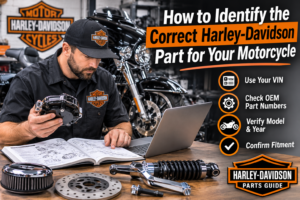
How to Identify Harley-Davidson Parts for Your Motorcycle: A Complete Guide
how to identify Harley-Davidson parts for your motorcycle is essential for maintaining performance, reliability, safety, and appearance. Whether you are replacing a worn component, upgrading your bike, or restoring an older Harley-Davidson model, choosing the right motorcycle part can make the difference between a successful installation and an expensive mistake. how to identify Harley-Davidson parts Black Dyna Tank
With so many Harley-Davidson models, engine configurations, production years, and aftermarket upgrades available, identifying the correct replacement part can sometimes be challenging. Parts that look nearly identical may have different mounting points, dimensions, electrical connections, or compatibility requirements. how to identify Harley-Davidson partsHarley Roadster Gas tank FXR Center fill 1983-85 XLS OEM Ironhead Sportster 4.2
Fortunately, there are several reliable ways to identify the right Harley-Davidson parts before making a purchase. how to identify Harley-Davidson parts Vivid Black Gas Fuel Tank Harley Touring Ultra Classic FLH 2003-2007 OEM
In this guide, we explain how to identify Harley-Davidson parts for your motorcycle, where to find important identification information, how to use OEM part numbers, and what to consider when shopping for genuine and aftermarket Harley-Davidson components. how to identify Harley-Davidson parts Chrome 21 inch spokes front wheel with tire
Why Know how to identify Harley-Davidson parts Matters
how to identify Harley-Davidson parts, Harley-Davidson motorcycles are manufactured across multiple model families, including Touring, Softail, Dyna, Sportster, and V-Rod. Each family includes different generations and configurations, meaning that parts are not necessarily interchangeable between models.
Even motorcycles from the same model family can have significant differences depending on their production year. how to identify Harley-Davidson parts Genuine OEM Harley Davidson FXR Center Fill Red Gas Tank FXRT FXRS
Choosing an incompatible part can lead to several problems:
- Installation difficulties: Incorrect mounting points, dimensions, or connections can prevent a component from fitting properly.
- Reduced performance: Components that are not designed for your motorcycle may negatively affect handling, engine performance, or electrical operation.
- Safety concerns: Incorrect brake components, suspension parts, and steering assemblies can compromise motorcycle safety.
- Additional expenses: Purchasing the wrong part can result in unnecessary shipping costs, returns, and installation expenses.
- Potential damage: Forcing an incompatible component into place can damage surrounding motorcycle parts.
Identifying the correct replacement component before ordering helps avoid these issues and ensures that your motorcycle receives the parts it needs. how to identify Harley-Davidson parts 2 Step saddlemen Seat Blue Diamond Stich
1. Identify Your Harley-Davidson Model and Production Year
The first step in finding the correct Harley-Davidson part is identifying your motorcycle’s exact model and production year.
Harley-Davidson produces different motorcycles with unique designs, mechanical configurations, and component requirements. Knowing only that you own a Harley-Davidson is not enough to establish parts compatibility.
For example, a Harley-Davidson Street Glide, Road Glide, Road King, and Electra Glide may share certain mechanical components, but their fairings, instrument panels, handlebars, and bodywork can differ significantly.
Start by identifying the following information:
- Motorcycle model year.
- Model name.
- Model designation.
- Engine configuration.
- Relevant production or trim differences.
Common Harley-Davidson model families include:
Touring Models
Touring motorcycles are designed for long-distance riding and include models such as:
- Street Glide
- Road Glide
- Road King
- Electra Glide
- Ultra Limited
Common replacement and upgrade parts include saddlebags, fairings, touring seats, handlebars, suspension components, and exhaust systems. how to identify Harley-Davidson parts Tallboy Harley seat
Softail Models
The Softail family includes motorcycles such as the Fat Boy, Heritage Classic, Breakout, and Low Rider variants.
When shopping for Softail components, pay attention to frame generation, engine configuration, mounting arrangements, and production year.
Dyna Models
Dyna motorcycles have distinctive chassis and suspension configurations. Parts such as triple trees, handlebars, gas tanks, shocks, and exhaust systems may vary between model years. how to identify Harley-Davidson parts Le Pera Kickflip Diamond Stitch Seat For Harley
Sportster Models
Sportster motorcycles include several generations and engine configurations. Replacement parts may differ depending on whether the motorcycle uses an Evolution or earlier engine platform.
how to identify Harley-Davidson parts, Identifying the precise model and year gives you a much stronger starting point when searching for replacement components. how to identify Harley-Davidson parts Mustang Vintage solo Seat Harley
2. Find Your Motorcycle’s VIN
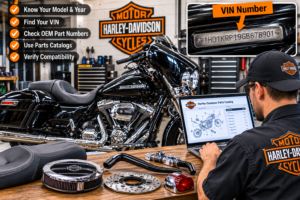
Your Harley-Davidson Vehicle Identification Number (VIN) is one of the most important tools for identifying your motorcycle.
A VIN is a unique identification code assigned to an individual motorcycle. It contains information that can help establish the vehicle’s manufacturer, model-related details, and production characteristics.
On many Harley-Davidson motorcycles, the VIN can be found in locations such as:
- Stamped into the motorcycle frame, commonly around the steering head.
- Displayed on the vehicle identification label.
- Recorded in the motorcycle’s registration documents.
VIN placement and format can vary depending on the motorcycle’s age and market.
Your VIN can help a Harley-Davidson dealer or knowledgeable parts specialist identify the correct motorcycle configuration and investigate compatible replacement components.
Important: A VIN is useful for vehicle identification, but it does not automatically guarantee that every replacement part listed for a particular model will fit. Production changes, previous modifications, and component revisions should also be considered. how to identify Harley-Davidson parts Dyna Thunderheader Exhaust
3. Use OEM Harley-Davidson Part Numbers
One of the most reliable ways to identify a replacement component is through its Original Equipment Manufacturer (OEM) part number.
OEM part numbers are identifiers assigned to components manufactured or specified for Harley-Davidson motorcycles.
These numbers help distinguish between parts that may look similar but have different specifications.
For example, Harley-Davidson uses individual part numbers for components such as:
- Electronic Control Modules (ECMs).
- Body Control Modules (BCMs).
- Turn signal modules.
- Speedometers and instrument clusters.
- Brake calipers.
- Fork assemblies.
- Gas tanks.
- Fairings.
- Transmission components.
- Engine assemblies.
If you are replacing an existing component, look for a part number printed, stamped, engraved, or displayed on the original part.
You can then compare that number with the replacement part listing.
When checking an OEM part number, consider the following:
- Confirm that the number has been recorded correctly.
- Check whether the replacement listing references the same number.
- Look for superseded or updated part numbers.
- Verify that the replacement is compatible with your motorcycle’s model and year.
- Confirm whether additional hardware or installation components are required.
A replacement part may have a different number from the original because Harley-Davidson has introduced an updated component. This does not necessarily mean that the replacement is incompatible.
However, always verify official supersession and fitment information before ordering. how to identify Harley-Davidson parts Black Chrome Contrast Cut Custom Wheels
4. Check Harley-Davidson Parts Catalogs and Fitment Guides
Parts catalogs and fitment guides are valuable resources when identifying the correct motorcycle component.
Harley-Davidson parts catalogs organize components according to motorcycle model families, production years, and specific assemblies.
They can help you identify:
- Original replacement part numbers.
- Component descriptions.
- Assembly diagrams.
- Related mounting hardware.
- Model-specific variations.
- Updated replacement numbers.
When searching through a parts catalog, make sure you are using the correct catalog for your motorcycle’s production year.
A parts diagram can also be particularly useful when replacing complex assemblies.
For example, if you are purchasing a Harley-Davidson front-end assembly, the diagram may show how the triple trees, fork tubes, bearings, spacers, and mounting hardware fit together.
You can consult an authorized Harley-Davidson dealership, official parts resources, or a reputable motorcycle parts supplier for assistance with identifying compatible components. how to identify Harley-Davidson parts chrome 21 inch mag front wheel package
5. Understand the Difference Between OEM and Aftermarket Harley-Davidson Parts
Another important consideration is whether you need an OEM replacement part or an aftermarket upgrade.
Both options can be useful, depending on your motorcycle, budget, and intended modifications.
OEM Harley-Davidson Parts
OEM parts are original equipment components manufactured by Harley-Davidson or supplied to its specifications.
Advantages include:
- Designed for specific Harley-Davidson applications.
- Established manufacturer part numbers.
- Easier compatibility verification.
- Original equipment specifications.
- Suitable for maintaining factory configurations.
how to identify Harley-Davidson parts, OEM parts are often preferred for restoration projects, original-equipment replacements, and motorcycles where maintaining factory specifications is important. Chrome spokes wheels and white walls tires
Aftermarket Harley-Davidson Parts
Aftermarket parts are produced by manufacturers other than Harley-Davidson.
They are available for a wide range of motorcycle upgrades and replacement applications.
Popular aftermarket Harley-Davidson components include:
- Performance exhaust systems.
- Custom handlebars.
- Adjustable suspension.
- Replacement fairings.
- Custom seats.
- Performance air cleaners.
- Upgraded brake components.
- Custom wheels.
- Engine accessories.
Aftermarket parts can provide additional styling options, performance characteristics, and customization opportunities.
However, compatibility should never be assumed simply because a product is advertised for Harley-Davidson motorcycles.
Always check the manufacturer’s fitment information, including model years, mounting requirements, and any additional installation considerations. how to identify Harley-Davidson parts Mustang Super Touring Deluxe Diamond One-Piece 2-Up Seat For Harley
6. Pay Attention to Harley-Davidson Model Generations
One of the most common mistakes when purchasing Harley-Davidson parts is assuming that all motorcycles with the same model name use identical components.
Harley-Davidson regularly introduces design and engineering changes throughout a model’s production history.
These changes can affect:
- Frame geometry.
- Engine configurations.
- Electrical systems.
- Suspension mounting points.
- Brake assemblies.
- Fuel tanks.
- Fairing designs.
- Exhaust mounting arrangements.
For example, a Softail motorcycle from an earlier production generation may use different frame and suspension components from a newer Softail.
Similarly, Dyna motorcycles produced in different years may require different electrical modules, mounting hardware, or body components.
When identifying replacement parts, always check the exact production year and model generation rather than relying on the model name alone.
This is particularly important when shopping for older Harley-Davidson motorcycles, discontinued models, and restoration projects. how to identify Harley-Davidson parts King tour pack with speakers
7. Check Part Dimensions and Physical Specifications
Part numbers and fitment guides are extremely useful, but physical specifications can provide another important layer of verification.
This is particularly relevant when purchasing aftermarket components or parts for older motorcycles that may have been modified.
Depending on the component, specifications worth checking include:
| Component | Important specifications |
|---|---|
| Handlebars | Diameter, width, rise, pullback, and wiring compatibility |
| Fork tubes | Length, diameter, and mounting configuration |
| Gas tanks | Capacity, mounting points, and fuel system compatibility |
| Brake calipers | Mounting arrangement, rotor compatibility, and brake specifications |
| Shocks | Length, mounting type, and suspension compatibility |
| Fairings | Mounting brackets, dimensions, and model-specific design |
| Wheels | Diameter, width, axle size, and brake configuration |
| Seats | Frame compatibility, mounting points, and rider position |
Do not rely on appearance alone.
Two Harley-Davidson components can look almost identical while having different dimensions or mounting requirements.
If you are uncertain, compare the original component’s specifications with the manufacturer’s replacement part documentation. how to identify Harley-Davidson partsBassani Mid-Length Super Bike Stainless Exhaust
8. Consider Electrical Compatibility When Buying Harley-Davidson Parts
Electrical components require special attention because different Harley-Davidson models and production years may use different wiring systems and electronic configurations.
For example, a motorcycle’s Electronic Control Module (ECM), Body Control Module (BCM), security system, and turn signal module may have specific compatibility requirements.
Before purchasing an electrical component, verify:
- Original OEM part number.
- Motorcycle model and production year.
- Connector type and pin configuration.
- Software or calibration requirements.
- Security system compatibility.
- Whether programming or additional setup is necessary.
A module that physically connects to your motorcycle may still be electronically incompatible.
This is especially important when replacing Harley-Davidson ECMs, ignition modules, speedometers, security modules, and other electronic components.
how to identify Harley-Davidson parts, Always consult the relevant manufacturer documentation or a qualified motorcycle technician before installing critical electrical components. Black Bassani 2-1 exhaust
9. Check Whether Your Harley-Davidson Has Previous Modifications
Not every Harley-Davidson motorcycle still has its original factory configuration.
Previous owners may have installed aftermarket handlebars, exhaust systems, suspension components, wheels, fairings, or electrical upgrades.
These modifications can affect which replacement parts your motorcycle needs.
For example:
- An aftermarket handlebar may require different control wiring.
- A custom exhaust may use different mounting brackets.
- Modified suspension may require specific shock dimensions.
- An aftermarket fairing may use non-original mounting hardware.
- A custom front end may require different fork tubes, triple trees, or brake components.
Before purchasing a replacement part, inspect the motorcycle and determine whether the original component has been modified.
If possible, identify the manufacturer and part number of the existing aftermarket component.
This is particularly important when buying used Harley-Davidson motorcycles or working on older custom builds. how to identify Harley-Davidson parts 2 into 1 chrome Bassani exhaust
10. Ask a Harley-Davidson Parts Specialist for Assistance
Sometimes, identifying the correct component requires additional research.
This is especially true for older motorcycles, discontinued parts, complicated electrical systems, and modified bikes.
A Harley-Davidson parts specialist can help verify:
- VIN-related model information.
- OEM part numbers.
- Replacement part compatibility.
- Superseded components.
- Model-year differences.
- Installation hardware requirements.
When requesting assistance, provide as much information as possible.
Useful information includes your motorcycle’s model, year, VIN, existing part number, and photographs of the component you want to replace.
Providing these details makes it easier to identify the correct replacement and avoid unnecessary purchases. how to identify Harley-Davidson parts Saddlemen Step-Up TTR Tuck and Roll Seat For Harley