
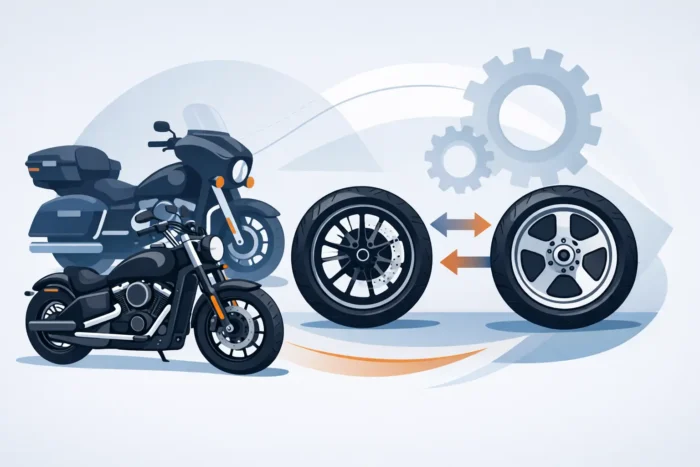
A clean take-off wheel can look like an easy score until it is sitting in the forks with the rotor in the wrong place, the axle loose in the bearings, or the speed sensor nowhere near its target. If you are asking which Harley models share wheels, the honest answer is that Harley wheel interchange is platform- and year-specific. The rim diameter is only the starting point. Hub width, axle diameter, bearing size, brake mounting, pulley or rotor offset, and ABS all decide whether that wheel actually belongs on your bike.
That does not mean swapping wheels has to be a headache. It means you need to buy by measurements and part details, not by a quick guess based on a 16-inch spoke wheel or a black mag wheel. That is how you keep your ride roaring without turning a bargain into a bench project.
Which Harley Models Share Wheels by Platform?
Harley-Davidson reused many wheel families within a production era, especially when models shared a chassis, fork setup, and brake package. The strongest matches are usually found within the same platform and a tight year range. A Dyna wheel is most likely to work on another Dyna of a similar generation. The same goes for Touring bikes, Softails, and Sportsters.
The catch is that even bikes in the same family can change axle sizes, bearing dimensions, brake rotors, or electronic equipment from one year to the next. A wheel that physically fits can still need different spacers, a matching rotor, or a hub conversion before it is safe to run.
Touring models: FLH, FLHX, FLTR, FLHR and FLHT
Touring wheels are commonly swapped among Road Kings, Street Glides, Road Glides, Electra Glides, and Ultra models when the years and brake setups line up. These bikes share a lot of chassis DNA, which makes their wheels some of the more interchangeable Harley parts on the used market.
For example, a non-ABS Touring front wheel from one late-model FLH or FLTR application may be a direct fit for another bike in the same generation if the axle, dual-disc arrangement, bearing setup, and rotor bolt pattern match. Rear wheels follow the same logic, but pulley offset and ABS provisions need attention.
Do not assume every 2009-up Touring wheel swaps with every other 2009-up bagger. Harley made changes through the years, and ABS wheels have sensor provisions that non-ABS bikes may not use. A non-ABS wheel can sometimes be installed on an ABS bike only with the correct components and sensor compatibility, but it is not a casual bolt-on job.
Dyna models: FXD, FXDL, FXDB, FXDWG and FXDF
Dyna wheels often interchange within their own era, particularly between standard FXD-based models with similar front-end and brake layouts. Low Riders, Street Bobs, Super Glides, Fat Bobs, and Wide Glides can share wheel components, but wide-front-end and dual-disc variations are where builders get caught.
A standard Dyna front wheel set up for a single disc does not automatically become a match for a dual-disc front end. The wheel may have mounting points for a second rotor, or it may not. Likewise, a Wide Glide has different front-end geometry and may use a different wheel width or spacer arrangement than a conventional Dyna.
Rear Dyna swaps deserve just as much inspection. Check whether the donor wheel was belt-drive, whether its pulley mounting surface matches, and whether the wheel centers correctly between your swingarm and brake caliper.
Softail models: FLST, FXST, FXSTS, FLS and FXBR
Softail wheel sharing depends heavily on generation. Earlier rigid-mount Evolution and Twin Cam Softails can share wheels across several Heritage, Fat Boy, Springer, Night Train, and Standard applications, but front-end style changes matter. Springer front wheels, for instance, are not a blind swap into conventional telescopic forks just because both bikes are Softails.
Later Softails need even closer scrutiny. The 2018-and-newer Softail platform is a major break from older designs. Fat Bob, Street Bob, Low Rider, Fat Boy, Breakout, and Heritage models use different wheel sizes, tire widths, brake configurations, and styling packages. Some parts can cross over with the right hardware, but treating the entire 2018-up Softail line as one wheel-fitment group is a fast way to order the wrong part.
Sportster models: XL, XLH, XL883 and XL1200
Sportster wheels are often easier to source because the XL platform stayed in production for decades, but the long production run is exactly why year matters. Earlier solid-mount Sportsters, later rubber-mount Sportsters, cast-wheel Customs, spoke-wheel standards, single-disc fronts, and dual-disc models do not all share the same setup.
Many 2000s Sportster wheels can trade places within that period when axle size, rotor placement, bearing dimensions, and brake configuration match. But a 21-inch single-disc front from one Custom model will not necessarily be a direct replacement for a 19-inch dual-disc wheel from a Roadster. It may fit the forks with parts changes, yet the brake system and handling package will be different.
Older Harley models: Shovelhead, Panhead and early FL
Vintage Harley wheel fitment is its own territory. A 16-inch star hub, a mechanical-drum front wheel, or an early hydraulic-disc assembly may appear across several years and models, but condition and originality matter as much as interchange.
Collectors restoring a Panhead, Shovelhead, early FLH, or period chopper need to verify hub casting details, brake side, spoke count, rim profile, and axle arrangement. A later wheel may be made to work, but it can hurt period correctness or require machining, custom spacers, and brake adaptation. For a rider build, that may be fine. For a factory-style restoration, it is usually the wrong move.
The Fitment Details That Decide a Harley Wheel Swap
Before you buy a wheel, compare the donor wheel to your original one on the bench. The following details are the real interchange checklist:
- Axle and bearing size: Harley used different axle diameters and bearing IDs across eras. A wheel can be the right diameter and still not accept your axle.
- Hub width and spacer stack: Measure from fork leg to fork leg or swingarm to swingarm, then account for every spacer. Centering the wheel is not optional.
- Brake setup: Confirm single or dual rotor mounting, rotor bolt pattern, rotor diameter, caliper location, and rotor offset.
- Rear drive side: Check pulley or sprocket bolt pattern, offset, belt alignment, and clearance for the tire and swingarm.
- ABS and speed sensing: Later wheels may use an ABS bearing, encoder, or sensor ring arrangement. Your bike needs the correct electronic relationship to keep ABS and speedometer functions working.
- Rim width and tire clearance: A wheel may mount but still be wrong for your tire, fender, fork brace, belt guard, or swingarm.
Part numbers are useful, but do not stop there. Harley often used related wheel assemblies with different finishes, bearings, rotor packages, or ABS variations. Compare the actual hub and hardware, especially when buying used parts.
Direct Fit, Compatible Fit and Custom Fit
There are three kinds of wheel swaps, and they should not be priced or planned the same way.
A direct fit uses the same axle, bearings, spacers, brake components, and drive arrangement. This is the ideal swap. It is the kind of wheel exchange commonly found between closely related Touring models or same-era Dynas.
A compatible fit requires matching components from the donor setup, such as rotors, spacers, a pulley, bearings, or an ABS-related part. It can be a solid upgrade when done correctly, but it needs a complete parts plan before you tear down the bike.
A custom fit requires fabrication, machining, custom spacers, brake-caliper relocation, a different axle, or major conversion parts. This is normal in chopper and performance builds, but it is not the same as interchange. If a seller says a wheel “fits Harley,” ask whether it is direct fit or custom-fit capable.
A Better Way to Buy Used Harley Wheels
When shopping used, start with your motorcycle’s year, exact model, and whether it has ABS. Then identify your front axle diameter, rotor count, wheel diameter, rear pulley type, and original wheel part number if available. Photos should show both sides of the hub, rotor mounting surfaces, bearing area, pulley side, and every included spacer.
If details are missing, ask for measurements. A used wheel with a known donor model is better than one described only as “Harley wheel.” For rare OEM, NOS, and vintage pieces, that extra verification protects both your build and your wallet.
At Harley Warehouse, the shelves cover modern bagger hardware, Dyna and Sportster take-offs, old-school hubs, and the hard-to-find parts that do not always show up in a basic catalog. Bring the exact year and model details when you call or email. It gives the parts crew a real shot at matching the wheel, spacers, rotors, and related hardware instead of selling you a guess.
The right wheel swap should look factory where it needs to and custom where you want it to. Measure twice, verify every brake and axle detail, and then get back to the part that matters: riding the machine you built.