
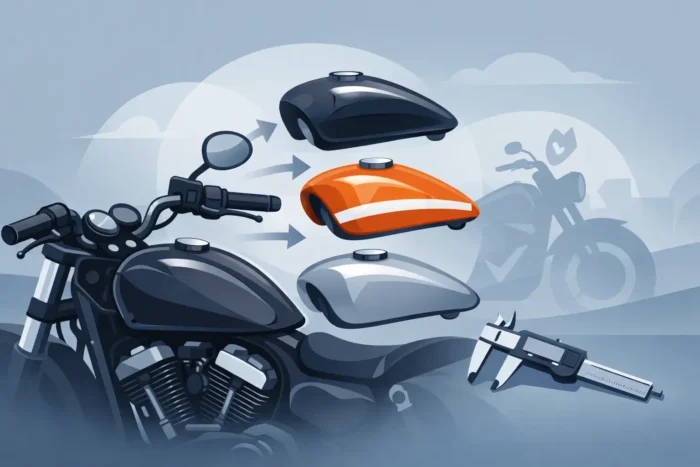
Harley tank compatibility
A gas tank can look right in a photo and still be dead wrong for your motorcycle. Harley tank compatibility comes down to more than the model name stamped on a listing. The frame backbone, mounting tabs, fuel delivery setup, seat line, console, and even handlebar clearance all decide whether that tank bolts on, needs fabrication, or belongs on a different build. Turtle Tank Ironhead Sportster 1963-1972
For riders replacing crash damage, builders changing a bike’s stance, and restorers chasing period-correct OEM parts, fitment is where the job starts. Measure first, compare the details, and you will avoid buying a tank that turns into an expensive garage ornament. Harley tank compatibility 5 Gallon Fatboy Gas tank 1979 Flh Shovel Head Oem Emblem mount Harley emblem
Start With Your Exact Harley Platform
“Fits Harley” is not a fitment category. A Sportster tank, a Dyna tank, a Softail tank, and an FLH touring tank may all wear Harley-Davidson badges, but their mounting locations and tunnel dimensions are built around very different chassis layouts. Harley tank compatibility Springer Front End
Start with the motorcycle’s full model, year, and engine family. A 1998 FXD is not automatically the same tank fit as a 2008 FXD, and a Softail frame change can affect far more than the visible shape of the tank. Touring models add another layer with dash panels, consoles, instrument layouts, and larger-capacity tanks designed around their specific frames. Harley tank compatibility Sugar Bear springer front end
For vintage iron, the model year matters even more. Panhead, Shovelhead, Ironhead Sportster, and early FL tanks can use parts that appear similar across decades but differ at the mounts, petcock location, trim holes, or tunnel. A correct-looking tank can be incorrect for a restoration if its badge mounts, filler neck, dash provisions, or crossover setup are from the wrong year range. Harley tank compatibility Chrome spokes wheels and white walls tires
When the bike is a custom, identify the frame rather than relying on the engine. A Shovelhead motor in an aftermarket rigid frame does not make it a stock Shovelhead tank application. The backbone width, stretch, neck height, and tank tab placement on that frame are the real fitment facts. Harley tank compatibility Black Bassani 2-1 exhaust
Harley Tank Compatibility Is a Mounting Job First
Before looking at paint, capacity, or badge style, compare how the tank attaches. Most fitment problems show up here.
Look at the front mount style, rear mount location, bolt size, and the distance between mounting points. Some Harley tanks use a front bracket or tab arrangement with rear mounting studs. Others use a different bracket layout, rubber isolators, or a center console that changes access to the hardware. Even a small difference in tab position can force the tank to sit crooked or contact the frame.
The tunnel is just as important. That recessed channel under the tank has to clear the backbone, wiring, coil area, and any frame gussets. A tunnel that is too narrow simply will not sit down where it belongs. One that is too wide may technically mount but can look wrong, shift under load, or leave ugly gaps along the frame. Harley tank compatibility
Do not assume a tank can be pulled into place by tightening the bolts. If the mounts are under tension, something is wrong. Forcing it can crack tabs, stress the tank seam, damage paint, or create a vibration issue that shows up miles later. Harley tank compatibility 21 Front single disc Spoke Wheel and Tire
Harley tank compatibility Check Seat, Fork, and Bar Clearance
A tank that fits the frame can still fight the rest of the bike. Check the rear of the tank against the seat nose and mounting bracket. Some tank swaps require a matching seat, while others need trimming or custom upholstery to close the gap cleanly.
Turn the forks lock to lock and check clearance at the front of the tank. Wide bars, tall risers, internal wiring, fairing brackets, and accessory switches can all change the space available. On a chopper or custom, a stretched tank may look mean until the fork stops or bar controls make contact with it. Harley tank compatibility 2000^ Harley Softail Dyna Wide Glide 41mm Front Fork Slider Legs Chrome
Also inspect clearance around rocker boxes, fuel lines, choke components on carbureted machines, and top-motor mounts where applicable. The cleanest builds are planned from all angles, not just from the side stand.
Match the Tank to the Fuel System
Carbureted and fuel-injected Harley tanks are not interchangeable without serious thought. This is one of the biggest points in Harley tank compatibility, especially on late-model bikes.
A carbureted tank generally uses a petcock outlet, often with a fuel line routed to the carburetor. Depending on the tank and year, it may also have a crossover line, vent fitting, or reserve arrangement. An EFI tank needs provisions for an internal fuel pump assembly, pump flange, electrical connector, pressure line, and the correct venting setup. Harley tank compatibility How to Install a Harley Peanut Tank (Step-by-Step Guide)
Trying to install a carbureted tank on an EFI bike is not a simple bolt-on swap. The tank must safely support the fuel system your motorcycle requires. Converting between carburetion and EFI can be done on purpose-built custom projects, but it involves far more than changing tanks. Fuel pressure, pump hardware, electronics, line routing, and tuning all have to match the setup.
Check the petcock or pump opening itself. The location, mounting pattern, and depth can vary. Verify whether the tank includes the petcock, fuel pump, sending unit, cap, crossover hardware, or mounting hardware. A used tank may be a solid deal, but missing pieces can add up fast.
Dash, Console, Cap, and Gauge Details Matter
Many Harley tanks carry more than fuel. They may support a dash panel, speedometer, ignition switch, fuel gauge, warning lights, or a center console. The holes and mounting points for these components are not universal.
If you are replacing a touring or cruiser tank and want to reuse your original console, confirm the console length, mounting holes, and fuel cap location. A tank may fit the frame but leave you with nowhere to mount the dash hardware. On some applications, the fuel gauge system also needs to match the bike’s wiring and sending unit. Harley tank compatibility Black Chrome Contrast Cut Custom Wheels
For stripped-down customs, deleting a console can clean up the top of the tank. Just be realistic about the work involved. Unused holes may need plugs, bodywork, welding, or a different dash solution. That is fine when it is part of the plan, not when it is discovered after the tank arrives.
OEM, Aftermarket, Used, and Vintage Tanks Have Different Trade-Offs
An OEM tank is usually the easiest route when the goal is stock fit, factory lines, and compatible hardware. For a restoration, correct OEM or NOS parts can also preserve the motorcycle’s value and appearance. The trade-off is availability. Older tanks in clean condition can be hard to find, and original paint or rare trim provisions can command real money.
Aftermarket tanks offer more shapes, capacities, and custom style options. Peanut tanks, Frisco-style tanks, stretched tanks, and wide custom tanks can completely change a build. But aftermarket fitment ranges from excellent to fabrication-required. Always treat phrases like “universal” or “for custom applications” as a signal to measure every mounting point and clearance area.
Used tanks deserve a close inspection. Look inside for rust, old liner failure, loose debris, and fuel residue. Check the bottom seam, petcock area, filler neck, mounting tabs, and underside for dents or repairs. A tank with a clean exterior can hide corrosion inside, and old fuel can create trouble long after installation.
At Harley Warehouse, the inventory can include used OEM pieces, vintage hardware, aftermarket options, and hard-to-find tanks from different Harley eras. That makes detailed questions worthwhile. Have your year, model, fuel system, measurements, and photos of your current mounting area ready before you call or email.
Harley tank compatibility Measure Before You Buy
You do not need a machine shop to make a smart tank decision. A tape measure, a few clear photos, and a careful look at the bike go a long way. Record the center-to-center distance between mounts, frame backbone width, tunnel width and depth, available fork clearance, and the distance to the seat.
Compare those numbers to the tank whenever possible. If the seller cannot confirm them, ask for photos of the underside, mounts, tunnel, petcock or pump opening, and console area. For an expensive vintage tank, those photos are part of buying responsibly. Harley tank compatibility Black/Chrome Switchblades Customized Mag wheels
If you expect to modify mounts, decide whether the tank is worth cutting, welding, and repainting before money changes hands. Rare OEM tanks and clean survivor pieces are usually better preserved. A common aftermarket tank may be the smarter canvas for a hardtail or one-off build.
The right tank should make the motorcycle look like it belongs there, but it also needs to mount without stress, feed fuel safely, and leave room for the parts that move. Get those details right first, then pick the paint that makes your ride roar. Harley tank compatibility Dyna Street Bob Triple trees 49mm Custom Top Clamp Harley FXD FXDL Mid Glide
Pingback: Harley Fitment Guide for Parts That Actually Fit - HARLEY WAREHOUSE
Pingback: How to Source Discontinued Harley Components - HARLEY WAREHOUSE