
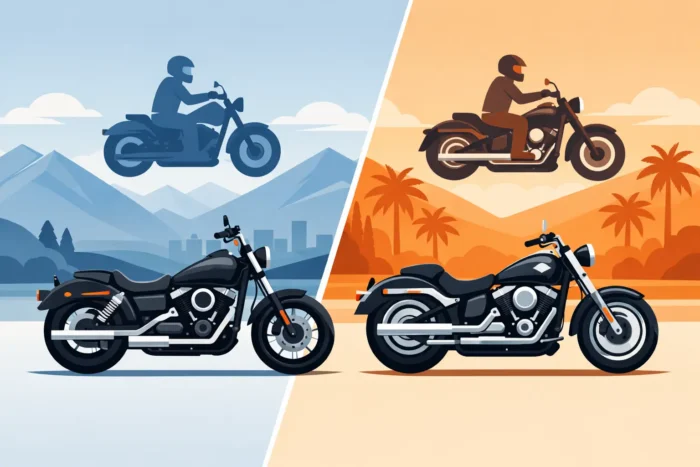
A Dyna Softail comparison is not just a spec-sheet argument. It comes down to what you feel through the bars, the floorboards or mids, and the seat when the road gets rough. One platform carries a raw, rubber-mounted street-bike attitude. The other puts traditional Harley lines, low-seat confidence, and long-haul comfort at the center of the ride.
Both platforms have earned loyal followings for good reason. A clean Dyna can become a hard-charging club-style build, a simple commuter, or a stripped-down custom with real cornering manners. A Softail can be a low-slung cruiser, a fat-tire showpiece, a comfortable two-up machine, or a modern performance bike depending on its generation. The right answer depends on the bike’s year, setup, condition, and what you want to do once the garage door opens.
Dyna vs. Softail: Start With the Frame
The classic Dyna chassis uses visible twin rear shocks and a rubber-mounted Big Twin engine. That design gives it a mechanical, alive feel. The motor shakes at idle, settles down underway, and the bike communicates plenty through the seat and bars. Dynas generally carry a more upright, narrow, and street-oriented stance than the traditional Softails built from the 1980s through 2017.
Softails went another direction. The older models hide their rear suspension beneath the frame to create the clean hardtail look Harley riders have loved for decades. A Heritage Softail, Fat Boy, Deluxe, or Night Train can look planted and low even though it has rear suspension. That look is a major part of the appeal, especially for classic custom builds.
Then 2018 changed the conversation. Harley replaced both the Dyna and older Softail families with a new Softail frame and mono-shock rear suspension. These newer bikes are lighter, stiffer, and more capable than many riders expect from the Softail name. Models such as the Low Rider S, Street Bob, Fat Bob, and Sport Glide carry much of the performance spirit that used to send riders hunting for a Dyna.
So, compare generations honestly. A 2006 Street Bob and a 2016 Fat Bob are much closer cousins in ride character than either is to a 1995 Heritage Softail. A 2022 Low Rider S is a different animal again.
Ride Feel and Handling
A Dyna usually feels more willing to be pushed through a back road. The chassis is relatively narrow, and the twin-shock layout makes it easy to understand what needs attention. Better shocks, fork springs, tires, and brake work can transform a used Dyna without changing its basic personality.
That does not mean every stock Dyna handles like a sport bike. Factory suspension varies widely by model and year, and plenty of bikes are running tired shocks, worn bushings, poor tires, or slammed rear ends. A low-budget custom may look right parked outside a bar and ride terribly on broken California pavement. Check the actual setup, not the decal on the tank.
Older Softails tend to favor relaxed cruising. Their low seat heights inspire confidence at stoplights, and many models offer a roomy rider triangle for easy miles. The trade-off is lean angle and suspension travel. Floorboards can touch down early, and a heavily lowered Softail may punish both rider and frame over potholes.
The newer Softails close the gap fast. Their frame rigidity and lighter overall feel make them far more responsive than older hidden-shock models. A current Low Rider S or Fat Bob can be ridden aggressively right out of the box, while a Street Bob gives builders a lean foundation for bars, suspension, wheels, and performance upgrades.
The Real Test Ride Question
Ask yourself where you ride most. If your favorite route includes canyon sweepers, fast city lanes, and solo runs, a Dyna or 2018-and-up performance-minded Softail makes sense. If your ride includes cruising, passenger time, highway miles, and a preference for low classic lines, an older Softail deserves serious attention.
Rider size matters too. A taller rider may appreciate the room available with the right Dyna controls and bars. A shorter rider may feel immediately at home on a low Softail. Neither platform is locked into its stock ergonomics, but changing controls, seats, bars, cables, and suspension adds real cost.
Engines: Evolution, Twin Cam, and Milwaukee-Eight
There is no single Dyna engine and no single Softail engine. Early Dynas and Softails can carry Evolution powerplants. These are simple, well-loved engines with huge aftermarket support, but age, maintenance history, oil leaks, charging systems, and worn top ends matter more than nostalgia.
From the late 1990s through 2017, many examples use Twin Cam power. Dynas received versions including the 88, 96, 103, and 110 depending on year and model. Softails got their own Twin Cam combinations, with differences in mounting, tuning, and factory configuration. A properly maintained Twin Cam can deliver miles of strong, familiar Harley torque. A neglected one can turn a good deal into a cam chest, oil pump, tensioner, clutch, and labor conversation.
The 2018-and-up Softail lineup brought the Milwaukee-Eight. It is smoother, stronger, and more refined in stock form, with a broad torque curve that makes heavier cruising and two-up riding easier. For riders who want modern braking, electronics, and a newer platform, this is a strong reason to shop current Softails.
Still, newer is not automatically better for every owner. Dynas have a massive custom scene, deep used-parts availability, and an honest garage-built quality that many riders specifically want. If you enjoy wrenching and building a bike around your own riding style, a solid Twin Cam Dyna can be hard to beat.
Custom Potential and Parts Reality
The Dyna remains one of Harley’s favorite starting points for club-style and performance builds. T-bars, risers, mids, better shocks, fork cartridges, fairings, upgraded brakes, two-into-one exhausts, and performance cams all have a well-established place in Dyna culture. FXD, FXDB, FXDC, FXDL, FXDF, and FXDWG models each bring different wheel, control, and styling combinations, so confirm fitment before buying parts.
Softails offer a different kind of freedom. The older chassis is ideal for riders chasing bobber, chopper, heritage, custom-cruiser, or fat-tire style. Tanks, fenders, handlebars, seats, wheels, exhaust systems, and period-correct hardware can change the entire look. But hidden shocks and model-specific rear sections can make some modifications less straightforward than they appear.
Modern Softails have quickly built their own aftermarket. Performance parts are especially strong for Low Rider S, Street Bob, Fat Bob, and Sport Glide owners. Be careful with broad listings that claim a part fits every Softail. The 2018-and-up platform does not share all the same mounting points or chassis dimensions as an earlier Twin Cam Softail.
When shopping used components, match the exact model year, engine family, wheel size, brake setup, and control configuration. A clean OEM takeoff can be a better buy than a mystery aftermarket part with missing hardware. For vintage projects, correct brackets, spacers, fasteners, and mounts often matter as much as the big-ticket piece.
What to Inspect Before You Buy
Condition should decide more than the platform badge. On a Dyna, inspect the swingarm area, rear shock mounts, motor mounts, neck bearings, fork tubes, and common wear points around controls and wiring. Watch for hacked fairing mounts, poorly routed cables, mismatched brake parts, and cut-up harnesses from unfinished custom work.
On an older Softail, look closely at the hidden rear suspension, frame condition, rocker covers, primary, transmission case, and the evidence of repeated lowering or bottoming out. Check whether aftermarket wheels, wide-tire kits, and custom fenders were installed with proper alignment and spacers. A good-looking bike with a crooked rear wheel is not a bargain.
For any Twin Cam, ask about cam chest service, maintenance records, charging health, and oil consumption. On Milwaukee-Eight models, examine service history, modifications, tuning, and whether the seller kept the original parts. A bike with thoughtful upgrades and receipts is usually easier to value than one with a pile of unexplained changes.
Which Harley Should You Roll Out On?
Choose a Dyna if you want the classic rubber-mounted Big Twin experience, visible shocks, a strong performance-custom foundation, and a bike that feels at home with bars, suspension, and road miles. Choose an older Softail if low-slung traditional Harley style, relaxed cruising, and custom visual impact are at the top of your list. Choose a newer Softail if you want modern power and handling without giving up the cruiser shape.
The best move is to buy the cleanest, most complete example you can afford, then build from there. A bike with the right frame, healthy engine, straight chassis, and correct hard-to-find pieces gives you more ride time and fewer expensive surprises. If you need help tracking down model-specific used, OEM, NOS, or custom parts, Harley Warehouse is built for the hunt. Get the fitment right, set the bike up for your roads, and let it earn its scars the right way.