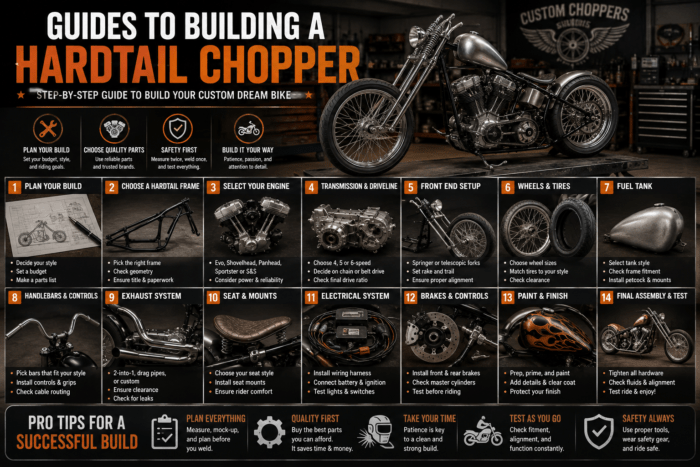
Guides to Building a Hardtail Chopper
Choosing the right hardtail frame is the most important decision in your custom motorcycle project and getting the right Guides to Building a Hardtail Chopper. The frame determines your bike’s stance, strength, handling, and how smoothly the rest of your components fit together. Rebuilt 103″ Engine Motor Harley B Softail Heritage Fatboy Twin Cam Springer
If you’re planning a traditional rigid build and searching for the perfect foundation, this Guides to Building a Hardtail Chopper will walk you through exactly how to choose the right hardtail chopper frame for your build. Chopper Frames for sale
What Is a Hardtail Chopper Frame?
A hardtail (rigid) frame has no rear suspension. The rear axle mounts directly to the frame, creating that clean, old-school chopper look.
Hardtail frames are popular because they:
- Deliver a minimalist, traditional style
- Reduce weight
- Simplify the mechanical setup
- Highlight craftsmanship
They’re especially common in builds using V-twin drivetrains inspired by Harley-Davidson platforms. Guides to Building a Hardtail Chopper Sugar Bear springer front end
Step 1: Decide on Your Build Style
Before buying a frame, ask yourself:
- Do you want a long-fork show bike?
- A low-slung bobber style?
- A classic 1970s chopper look?
- A performance-focused rigid build?
Your style determines:
- Rake angle
- Stretch length
- Wheel size
- Tire width
Don’t buy a frame first and figure it out later. Plan the entire build vision. Guides to Building a Hardtail Chopper Chopper Frames for sale
Step 2: Understand Rake & Trail
Rake is the angle of the neck where the front forks attach.
Common Rake Angles:
- 30°–34° – Mild custom look, better handling
- 35°–38° – Classic chopper stance
- 40°+ – Aggressive long-fork build
More rake increases visual impact but affects handling. Trail measurement must remain correct for safe riding.
If you’re new to building, staying within the 30°–38° range is usually safer and easier to manage. Guides to Building a Hardtail Chopper 21 inch front spoke wheel and Tyre
Step 3: Choose the Right Stretch
Stretch refers to how much longer the frame is compared to stock.
Types of stretch include:
- Backbone stretch
- Downtube stretch
- Rear section stretch
More stretch = longer stance and more dramatic appearance.
However, excessive stretch can:
- Complicate wiring and cables
- Require extended forks
- Increase overall build cost
Balance style with practicality. Guides to Building a Hardtail Chopper How to Choose the Right Hardtail Chopper Frame for Your Build
Step 4: Confirm Engine Compatibility
Not all hardtail frames fit every engine.
Before purchasing, verify:
- Engine type (Evo-style, aftermarket V-twin, etc.)
- Transmission configuration
- Primary drive setup
- Rear wheel spacing
Many frames are designed around engines similar to those used in Harley-Davidson models.
Incorrect compatibility leads to expensive fabrication and alignment issues.
Step 5: Check Frame Material & Weld Quality
Your safety depends on frame quality.
Look for:
- DOM (Drawn Over Mandrel) steel tubing
- Reinforced neck gussets
- Clean, consistent weld penetration
- Proper axle plate alignment
Avoid frames with sloppy welds, uneven tubing, or visible warping. Guides to Building a Hardtail Chopper New Dual Disk Forks Tubes Sliders Harley touring Ultra Classic Glide
Step 6: Decide Between Full Frame vs Weld-On Hardtail
You have two main options:
Full Hardtail Frame
- Entire frame built rigid
- Cleanest look
- Best alignment
- Ideal for full custom builds
Weld-On Hardtail Kit
- Converts stock frame into rigid
- Lower cost
- Requires precision cutting and welding
If you want fewer complications, a full hardtail frame is usually the better choice. Guides to Building a Hardtail Chopper Mustang DayTripper Low Profile Seat Harley Dyna FXD Low Rider Street Bob 2006
Step 7: Consider Registration & Documentation
If you plan to ride on public roads, confirm whether the frame includes:
- Manufacturer Statement of Origin (MSO)
- VIN documentation
- Titled options (if available)
Always check local laws before ordering.
Step 8: Set a Realistic Budget
Beyond the frame cost, factor in:
- Front end setup
- Wheels and tires
- Brakes
- Engine and transmission
- Electrical components
- Paint and finishing
A quality frame is an investment — not an expense to minimize. Guides to Building a Hardtail Chopper OEM Vivid Black Front Fender FLHX FLTR Street Road Glide 14^ Factory Harley T/O