
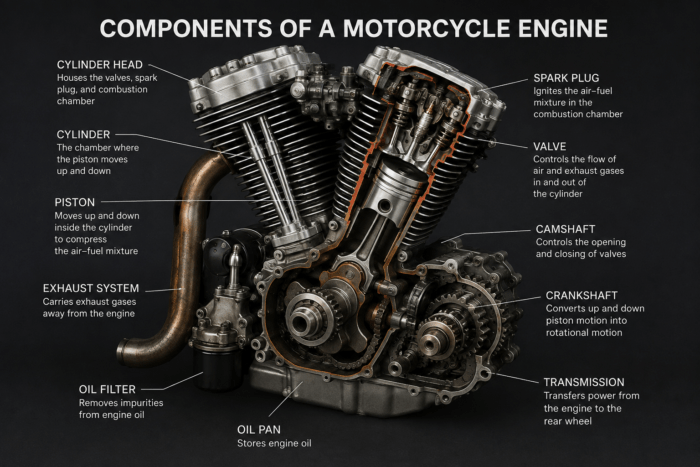
Components of a Motorcycle Engine: Complete Guide for Beginners
Understanding the components of a motorcycle engine is important for anyone who owns, repairs, modifies, or shops for motorcycle parts. Whether you ride a Harley-Davidson, sport bike, cruiser, touring motorcycle, or dirt bike, the engine relies on several components working together to convert fuel and air into mechanical power. Rebuilt 103″ Engine Motor Harley B Softail Heritage Fatboy Twin Cam Springer
In this guide, we explain the major motorcycle engine components, what each part does, and how they work together to power your motorcycle.
What Are the Main Components of a Motorcycle Engine?
A motorcycle engine contains many individual parts, but the major components typically include:
- Engine block or crankcase
- Cylinder
- Cylinder head
- Piston
- Piston rings
- Connecting rod
- Crankshaft
- Camshaft
- Valves
- Timing system
- Spark plug
- Fuel injection or carburetor
- Intake system
- Exhaust system
- Lubrication system
- Cooling system
- Flywheel
- Clutch and transmission
The exact design varies depending on the motorcycle’s engine type, displacement, number of cylinders, and manufacturer. Components of a Motorcycle Engine Black Chrome Contrast Cut Custom Wheels
1. Engine Block and Crankcase
The crankcase is the main lower housing of a motorcycle engine. It contains and supports important components such as the crankshaft, bearings, transmission components on many motorcycles, and lubrication passages.
On many motorcycle engines, the crankcase is divided into sections that allow technicians to access internal components during engine service or rebuilding.
The crankcase also helps maintain structural rigidity and contains engine oil required for lubrication.
2. Cylinder
The cylinder is where the piston moves up and down during the combustion cycle. Components of a Motorcycle Engine Two Brothers S1R Slip-On Exhaust
Motorcycle engines may have one or multiple cylinders. For example, motorcycles can use:
- Single-cylinder engines
- Parallel-twin engines
- V-twin engines
- Inline-three engines
- Inline-four engines
- V4 engines
- Other configurations
Cylinder displacement contributes to the engine’s total size and performance characteristics. Components of a Motorcycle Engine Alpinestars Tech-Air Off-Road Airbag System
3. Cylinder Head
The cylinder head sits above the cylinder and forms the combustion chamber together with the piston and cylinder.
Depending on the engine design, the cylinder head contains components such as:
- Intake valves
- Exhaust valves
- Valve springs
- Camshafts
- Rocker arms
- Spark plugs
- Intake and exhaust ports
The cylinder head plays an important role in airflow, combustion, cooling, and overall engine performance. Components of a Motorcycle Engine Black Thunderheader Exhaust pipe
4. Piston
The piston is one of the most important moving components inside a motorcycle engine.
During operation, combustion pressure pushes the piston down the cylinder. The piston then transfers this force through the connecting rod to the crankshaft. Components of a Motorcycle Engine Saddlemen Roadsofa HC Honeycomb 2-Up Seat For Harley
The piston repeatedly moves between:
- Top dead center (TDC)
- Bottom dead center (BDC)
This reciprocating motion is ultimately converted into rotational motion by the crankshaft. Components of a Motorcycle Engine Harley Davidson 30×4 Ultima 48 King Spoke Fat Black Front Wheel
5. Piston Rings
Piston rings fit into grooves around the piston and perform several important functions.
They help:
- Seal combustion pressure
- Control engine oil
- Transfer heat from the piston to the cylinder wall
Worn piston rings can contribute to reduced compression, increased oil consumption, smoke, and reduced engine performance.
6. Connecting Rod
The connecting rod connects the piston to the crankshaft.
It transfers the piston’s reciprocating movement to the crankshaft, allowing the engine to produce rotational power.
The connecting rod must withstand significant forces and repeated high-speed movement, making its strength and lubrication critical to engine reliability. Components of a Motorcycle Engine 30 inch King Spoke front wheel
7. Crankshaft
The crankshaft converts the piston’s up-and-down movement into rotational movement.
This rotation ultimately provides power to the motorcycle’s drivetrain.
The crankshaft is supported by bearings inside the crankcase and is designed to withstand the forces generated during combustion.
In multi-cylinder engines, crankshaft design also helps determine the engine’s firing characteristics, vibration, and overall character.
8. Camshaft
The camshaft controls when the engine’s valves open and close.
Depending on the engine design, the camshaft may be located in the cylinder head or lower in the engine.
The camshaft uses specially shaped lobes to operate the valve train at precise points during the engine cycle.
Performance camshafts can alter valve timing and lift, potentially changing an engine’s power characteristics. Components of a Motorcycle Engine WHEEL SPACERS +2.5 CM EPI 4/110 10X1.
9. Intake and Exhaust Valves
Motorcycle engines generally use intake valves and exhaust valves.
Intake Valves
Intake valves allow the air-fuel mixture, or air in fuel-injected systems, to enter the combustion chamber.
Exhaust Valves
Exhaust valves open to allow combustion gases to leave the cylinder and enter the exhaust system.
Correct valve timing is essential for efficient engine operation.
10. Timing System
The timing system synchronizes the crankshaft and camshaft so that the valves operate at the correct time relative to piston movement.
Motorcycle engines may use:
- Timing chains
- Timing gears
- Timing belts
A timing failure can cause serious engine damage on interference engines, making proper maintenance important.
11. Spark Plug
The spark plug is used in gasoline motorcycle engines to ignite the compressed air-fuel mixture inside the combustion chamber.
The ignition system generates a high-voltage electrical pulse that creates a spark across the spark plug gap.
A properly functioning spark plug is essential for starting, combustion, fuel efficiency, and engine performance. Components of a Motorcycle Engine Saddlemen Step-Up TTR Tuck and Roll Seat For Harley
12. Fuel Injection System or Carburetor
The engine needs the correct amount of fuel to operate.
Older motorcycles commonly use carburetors, while most modern motorcycles use electronic fuel injection.
A fuel injection system typically includes:
- Fuel injectors
- Fuel pump
- Fuel rail
- Sensors
- Electronic control unit (ECU)
The ECU controls fuel delivery based on information from various engine sensors.
13. Intake System
The intake system delivers air to the engine.
Typical components can include:
- Air filter
- Airbox
- Intake manifold
- Throttle body
- Intake runners
Clean and unrestricted airflow is important for proper combustion. Components of a Motorcycle Engine 30 inch King Spoke front wheel
This is why motorcycle owners often upgrade their air intake systems when modifying engine performance.
14. Exhaust System
The exhaust system removes combustion gases from the engine.
It can include:
- Exhaust headers
- Collector
- Muffler
- Catalytic converter
- Oxygen sensors
Aftermarket motorcycle exhaust systems can change exhaust flow, sound, appearance, and potentially engine performance.
For performance modifications, exhaust changes may need to be considered together with air intake and ECU tuning.
15. Lubrication System
The lubrication system circulates engine oil throughout critical components.
Engine oil helps:
- Reduce friction
- Remove heat
- Protect moving components
- Reduce wear
- Carry contaminants toward the oil filter
Depending on the motorcycle, lubrication systems may use wet-sump or dry-sump designs.
Regular oil and filter changes are among the most important motorcycle engine maintenance tasks.
16. Cooling System
Motorcycle engines generate substantial heat during operation.
There are two common cooling methods:
Air Cooling
Air-cooled engines use airflow and cooling fins to dissipate heat.
Liquid Cooling
Liquid-cooled engines use coolant flowing through passages around the engine. The heated coolant travels to a radiator where heat is released into the surrounding air.
Some motorcycles use combinations of air and oil cooling as well.
17. Flywheel
The flywheel helps maintain smooth crankshaft rotation by storing rotational energy.
It can also be incorporated into the motorcycle’s charging and ignition systems depending on the engine design.
The flywheel contributes to engine smoothness and helps the engine maintain momentum between combustion events.
18. Clutch and Transmission
Although the clutch and transmission are not technically part of the engine’s combustion mechanism, they are essential components of the motorcycle powertrain.
The clutch allows the rider to disconnect the engine from the transmission temporarily.
The transmission uses different gear ratios to transfer engine power to the rear wheel while allowing the motorcycle to operate effectively at different speeds.
How Components of a Motorcycle Engine Work Together
The four-stroke motorcycle engine is commonly described through four basic stages:
1. Intake
The piston moves downward while the intake valve opens, allowing air or an air-fuel mixture into the cylinder. Components of a Motorcycle Engine Mustang touring Seat 1996-2003 Harley Dyna Superglide Low Rider Studs FXD FXDL
2. Compression
The piston moves upward while the valves remain closed, compressing the mixture.
3. Power
The spark plug ignites the compressed mixture. Expanding combustion gases push the piston downward.
4. Exhaust
The piston moves upward while the exhaust valve opens, pushing combustion gases out of the cylinder.
The crankshaft converts this piston movement into rotational power that eventually reaches the motorcycle’s rear wheel.
Motorcycle Engine Components and Performance
Changing individual engine components can affect motorcycle performance.
For example:
| Component | Potential Performance Effect |
|---|---|
| Air intake | Airflow |
| Exhaust | Exhaust flow and sound |
| Camshaft | Valve timing and power characteristics |
| Piston | Compression and displacement |
| Cylinder | Engine displacement |
| Cylinder head | Airflow and combustion |
| Fuel injectors | Fuel delivery |
| ECU | Fuel and ignition control |
| Crankshaft | Engine balance and stroke |
| Clutch | Power transfer |
Performance upgrades should be considered as a complete system rather than isolated parts.
For example, installing a high-flow intake and aftermarket exhaust may require appropriate fuel and ignition calibration depending on the motorcycle. Components of a Motorcycle Engine Chrome spokes wheels and white walls tires
Common Motorcycle Engine Problems
Understanding engine components also makes it easier to recognize potential problems.
Common symptoms include:
- Hard starting
- Rough idle
- Loss of power
- Excessive engine noise
- Excessive oil consumption
- Engine overheating
- Poor fuel economy
- Excessive exhaust smoke
- Misfires
- Low compression
- Oil leaks
These symptoms can have multiple causes, so proper diagnosis is important before replacing engine components. Components of a Motorcycle Engine black TBR Harley exhaust for sale
Pingback: Harley Fitment Guide for Parts That Actually Fit - HARLEY WAREHOUSE
Pingback: What Harley Years Interchange Parts? Fitment Guide - HARLEY WAREHOUSE
Pingback: how hot does harley exhaust get - HARLEY WAREHOUSE
Pingback: how to remove exhaust baffles on a harley davidson-