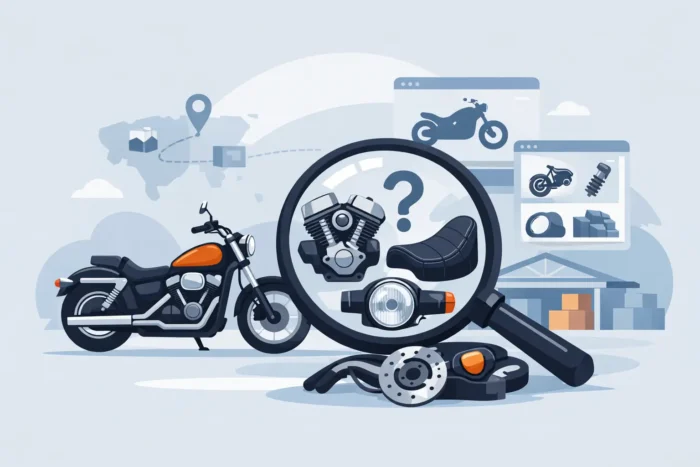
That missing part can stop a build cold. A cracked FLH fairing bracket, an early Sportster oil tank, a Dyna side cover in the right color, or one factory spacer can turn a running bike into a garage fixture. When you need to source discontinued Harley components, the answer usually is not a quick catalog search. It is knowing exactly what you have, what will interchange, and where old inventory still lives.
For riders, builders, restoration shops, and collectors, discontinued does not always mean unavailable. It means the part has moved out of the normal supply chain. It may still be sitting on a used bike, in an old dealer take-off pile, inside a private collection, or on a warehouse shelf that has not been photographed yet.
Start With the Part, Not the Name
Harley parts get described ten different ways. One seller calls it a “rear brake lever,” another calls it a pedal, and a third lists only a factory part number. Searching by a broad name can bury the exact piece under pages of near-matches.
Start by identifying the motorcycle’s year, model, engine family, frame style, and any major changes made before you owned it. A 1999 FXD that has been converted with later forks, custom wheels, or a different front brake setup may need a part that matches the conversion, not the VIN year. The same is true for choppers and restorations built from mixed-era components.
If possible, find the original OEM part number from a factory parts book, service manual, old receipt, casting mark, or the part itself. That number is the strongest search term you have. Add the model range and a plain-language description when searching, because listings are not always indexed perfectly.
Take clear photos before you start calling around. Photograph mounting points, thread sizes, connector ends, bends, casting numbers, and the damaged area. A good photo often answers the question that a vague description cannot: whether a replacement is actually close enough to work.
Know What Can Interchange
Not every discontinued item needs an exact year-and-model replacement. Many Harley components were used across several model families, while others changed in small but critical ways. A bracket may look identical but have a different mounting offset. A wheel spacer may fit the axle but put the rotor out of line. An ignition module may plug in but be wrong for the engine and year.
For fitment-sensitive parts, confirm the measurements that matter: mounting-hole spacing, axle diameter, rotor offset, fork tube diameter, belt or chain alignment, connector pin count, and left-versus-right orientation. On sheet metal, check tunnel width, dash mounts, petcock location, seat tabs, and tank mounting points.
There is a trade-off here. An exact OEM replacement is usually best for a correct restoration and tends to preserve value. A compatible used or aftermarket substitute may be the smarter move for a rider who wants to get back on the road. Be honest about the goal before spending collector money on a part that will live under a saddlebag.
Where to Source Discontinued Harley Components
The strongest search strategy uses more than one channel. Factory dealers may still locate old stock through legacy inventory networks, especially for later-model parts. That route is worth trying when you have a clean part number, but do not expect every obsolete item to appear in a dealer system.
Specialized motorcycle warehouses and used-parts operations are often where the real hunt begins. These businesses buy complete motorcycles, take-offs, old shop stock, estate inventory, and parts lots. Their websites may show only a fraction of what is physically on hand. For rare hardware, vintage tin, early drivetrain pieces, and oddball brackets, a direct phone call or email with your part number and photos can beat hours of online scrolling.
Harley Warehouse in Fresno works this way: the online inventory is a working sample, while the physical operation can include used, OEM, NOS, aftermarket, and vintage pieces from multiple eras. If your search involves an early Shovelhead item, a discontinued bagger component, or an unlisted factory take-off, provide the details needed for someone to check shelves instead of asking only, “Do you have one?”
Swap meets, motorcycle salvage yards, private seller groups, and vintage events remain valuable, especially for 1930s through 1970s parts. They also demand more patience. You may find the exact piece at a swap meet, but you may not get the return policy, part history, or knowledgeable fitment support available from a dedicated parts seller.
Online marketplaces can help, but search carefully. Use saved searches with the OEM number, common nicknames, model abbreviations, and misspellings. Sellers regularly list parts from a garage cleanout without knowing what they fit. That creates opportunity, but it also creates expensive mistakes.
Ask the Questions That Save a Second Purchase
A discontinued part is not automatically a usable part. Before buying, ask whether the part is OEM, NOS, used OEM, reproduction, or aftermarket. Those labels matter.
NOS means new old stock, typically an older genuine part that was never installed. It can be ideal for a period-correct build, but age still matters. Rubber seals harden, plated surfaces can pit, and old packaging does not guarantee that every internal piece is perfect. Used OEM parts may show wear but can be better made and better fitting than a low-grade reproduction.
For any used component, ask about cracks, stripped threads, repairs, missing hardware, corrosion, modifications, and known damage. On electrical parts, ask whether the item was tested and how. On suspension and brake pieces, do not treat a clean appearance as proof of safe condition. A used caliper, master cylinder, fork leg, or wheel should be inspected and rebuilt as needed before it goes back into service.
Photos should show more than the good side. Request close-ups of casting numbers, mounting tabs, connector pins, sealing surfaces, and wear areas. If the seller cannot provide them, decide whether the price reflects that uncertainty.
Watch for These Common Fitment Traps
A few areas cause repeat problems for Harley owners sourcing older parts. Electrical systems are one. Harley changed charging, ignition, switch housing, and connector arrangements over the years. A module or harness can look right until it meets the wrong plug or calibration.
Wheels and brakes are another. Axle size, bearing setup, rotor placement, pulley alignment, and caliper spacing must work together. Buying a wheel because it is the right diameter is not enough.
Touring-model bodywork can also be deceptive. Fairings, lowers, lids, consoles, and mounting hardware may vary between generations even when the profile looks familiar. Measure first, then confirm the part number.
Finally, do not overlook small hardware. Correct factory fasteners, clips, washers, bushings, and spacers are often harder to locate than the major assembly. Keep every original piece until the replacement is installed. The damaged spacer or broken bracket may still provide the dimensions needed to find the right part.
Build a Search Request That Gets Results
When contacting a seller, lead with the hard facts. State the year, model, exact part name, OEM number if known, condition you can accept, and whether you need a restoration-correct item or a functional replacement. Include photos and measurements when there is any doubt.
A useful request sounds like this: “Looking for an OEM left-side oil tank for a 1978 FLH. Part number preferred, used condition is fine if mounts are solid and the tank is not repaired. Please confirm petcock location and send photos of the rear tabs.” That gives a parts counter or warehouse team something they can actually search.
Avoid assuming a seller can identify every part from a one-line message. The more accurate information you provide, the faster you can separate a real lead from a dead end. Good communication also matters when the part is rare. If the right piece shows up, being ready to confirm fitment and buy can make the difference.
Decide When to Repair, Reproduce, or Keep Hunting
Sometimes the right move is repairing the original. A skilled metalworker can save a rare tank tab, exhaust bracket, floorboard mount, or steel fender that would be nearly impossible to replace. A reputable electrical specialist may restore certain gauges, generators, and older components when a replacement cannot be found.
Reproduction parts make sense when the original is common-looking, safety-critical, or not central to the bike’s value. A rider-grade build does not always need an expensive NOS item. Still, compare the reproduction carefully. Poor chrome, thin stampings, wrong thread pitch, and sloppy mounting holes can create more work than they save.
Keep hunting for OEM when authenticity, resale value, exact fit, or period detail matters. On a collector machine, the right factory component can be worth the time. On a daily rider, the best part is often the one that fits correctly, works safely, and gets the bike back under you.
The old Harley part you need may not be sitting in a polished online catalog. Get the number, verify the measurements, send useful photos, and ask a real parts person to look beyond the screen. That is how stalled projects start moving again – and how your ride gets back where it belongs: on the road.