
FXR Thunderheader vs 2-Into-1 Exhaust: Which Makes More Power?
If you’re building a performance-focused FXR, fxr thunderheader 2 into 1 exhaust is one question that always comes up: Should you run a Thunderheader or a different 2-into-1 exhaust? 2 into 1 chrome Bassani exhaust
Both options are popular among riders of motorcycles from Harley-Davidson, especially those tuning club-style or torque-heavy FXR builds. But when it comes down to raw power, throttle response, and usable torque — which one actually makes more power?
Let’s break it down. fxr thunderheader 2 into 1 exhaust Chrome Thunder-header exhaust system
Understanding the Basics: What Is a 2-Into-1 Exhaust?
A 2-into-1 exhaust system merges both header pipes into a single collector and exit pipe. This design improves exhaust scavenging, meaning the outgoing exhaust gases help pull fresh air/fuel mixture into the combustion chamber.
Benefits of 2-into-1 systems:
- Stronger mid-range torque
- Better throttle response
- More efficient exhaust flow
- Typically better dyno numbers than dual exhaust systems
The Thunderheader is actually a specialized version of a 2-into-1 system — but with its own collector design and tuning characteristics. fxr thunderheader 2 into 1 exhaust harley fishtail exhaust pipes
What Makes the Thunderheader Different?
The FXR Thunderheader, produced by Thunderheader, is known for its patented collector design. Unlike many generic 2-into-1 systems, Thunderheader focuses heavily on exhaust pulse timing and scavenging efficiency.
Key design differences:
- Tuned collector system
- Specific backpressure balance
- Performance-focused engineering
- Aggressive megaphone-style exit
It’s designed primarily for torque and strong mid-range pull — which is where FXR riders spend most of their riding time. fxr thunderheader 2 into 1 exhaust Khrome Werks Two Step Drag Style Pipes Exhaust Chrome Headers Sportster 2004^ Bi
Which Makes More Power on an FXR?
🔥 Short Answer:
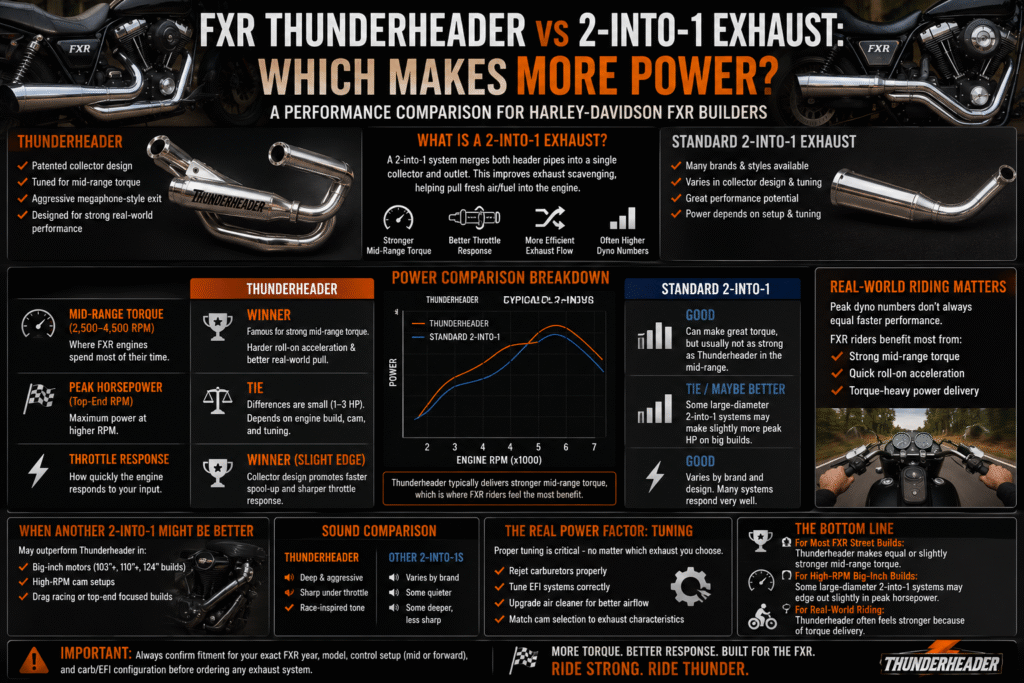
A properly tuned Thunderheader typically makes equal or slightly more mid-range torque compared to many standard 2-into-1 exhaust systems.
However, peak horsepower differences are often small and depend heavily on tuning, cam selection, and engine setup.
Power Comparison Breakdown
1. Mid-Range Torque (2,500–4,500 RPM)
Winner: Thunderheader
The Thunderheader is famous for strong mid-range power. On FXR builds, this translates to:
- Harder roll-on acceleration
- Stronger pull in city riding
- Better real-world rideability
For club-style riders or aggressive street builds, this matters more than peak dyno numbers.
2. Peak Horsepower (Top-End RPM)
Tie — Depends on Setup
Some high-end 2-into-1 systems with larger head pipes may produce slightly better top-end horsepower on heavily modified engines.
But on stock or mildly upgraded FXR motors:
- The difference is often minimal (1–3 HP range)
- Proper tuning matters more than brand choice
3. Throttle Response
Winner: Thunderheader (Slight Edge)
Because of its collector design, many riders report:
- Faster throttle response
- Quicker engine revving
- More aggressive acceleration feel
Dyno Numbers vs Real-World Riding
Here’s something many buyers overlook:
Peak dyno horsepower doesn’t always equal faster street performance.
The FXR is known for:
- Strong mid-range riding
- Quick roll-on acceleration
- Torque-heavy riding style
That’s why many FXR enthusiasts prioritize torque curves over top-end horsepower.
In real-world street riding, a torque-heavy exhaust like a Thunderheader often feels faster. fxr thunderheader 2 into 1 exhaust Fishtails Chrome Exhaust Pipes For Harley
When a Standard 2-Into-1 Might Be Better
There are cases where another 2-into-1 exhaust may outperform a Thunderheader:
- Big-inch motors (103+, 110+, 124 builds)
- High-RPM cam setups
- Drag-focused builds
- Engines tuned specifically for top-end horsepower
In those cases, head pipe diameter and collector size play a bigger role. fxr thunderheader 2 into 1 exhaust
fxr thunderheader 2 into 1 exhaust Sound Comparison
Although this article focuses on power, sound often influences buying decisions.
Thunderheader Sound:
- Deep and aggressive
- Sharp under throttle
- Recognizable performance tone
Other 2-Into-1 Systems:
- Varies by brand
- Some are quieter
- Some are deeper but less sharp
Sound preference won’t affect horsepower directly, but rider perception of power often correlates with exhaust tone. Chrome Thunder-header exhaust system
The Real Power Factor: Tuning
No matter which exhaust you choose, proper tuning is critical.
To maximize power:
- Rejet carburetors properly
- Tune EFI systems correctly
- Upgrade air cleaner for improved airflow
- Match cam selection to exhaust characteristics
A poorly tuned Thunderheader will make less power than a properly tuned generic 2-into-1. fxr thunderheader 2 into 1 exhaust
So, Which Makes More Power?
For Most FXR Street Builds:
👉 Thunderheader makes equal or slightly stronger mid-range torque. fxr thunderheader 2 into 1 exhaust
fxr thunderheader 2 into 1 exhaust For High-RPM Big-Inch Builds:
👉 Some large-diameter 2-into-1 systems may edge out slightly in peak horsepower.
For Real-World Riding:
👉 Thunderheader often feels stronger because of torque delivery. fxr thunderheader 2 into 1 exhaust harleydavdison.com
Pingback: Harley Exhaust System Upgrade for Better Sound - HARLEY WAREHOUSE
Pingback: Used Motorcycles Worth Buying and Building - HARLEY WAREHOUSE
Pingback: Thunderheader FXR Fitment Guide by Year - HARLEY WAREHOUSE
Pingback: Thunderheader for FXR Installation Guide - HARLEY WAREHOUSE